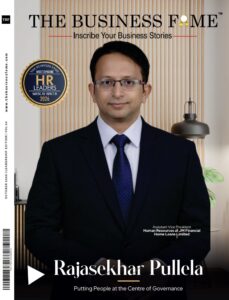
Behind every financial institution is a workforce that keeps its systems moving, serves customers, manages responsibilities, and responds to constant regulatory demands. In such an environment, human resources has to balance two important needs: the discipline required by the business and the human needs of the people within it. Good HR practices are not only about policies and processes. They also shape how employees experience their workplace, understand their responsibilities, and feel supported while meeting demanding expectations.
This balance has defined the career of Rajasekhar Pullela, Assistant Vice President – Human Resources at JM Financial Home Loans Limited. With over 21 years of experience in the BFSI sector, he has built a diversified perspective across insurance, banking, and NBFCs, with a focus on HR governance, compliance, and employee engagement. His work has included developing governance frameworks aligned with RBI requirements, strengthening ethical workplace practices, and supporting initiatives that build employee trust, including the Great Place to Work certification process.
His interest in HR comes from a simple belief that people are the backbone of every organization. For Rajasekhar, leadership lies in creating policies that balance business requirements with employee well-being. His work in DPDP Act compliance has also extended beyond his corporate responsibilities. He has authored publications and conducted external training on the Act, contributing to greater awareness of HR legal compliance across the BFSI sector.
Alongside his professional responsibilities, Rajasekhar is the author of books on the DPDP Act and Telangana Advocate Protection Act and is an active member of an NGO. These interests reflect his philosophy of the “concept of living,” which connects professional excellence with contributing to society.
Shaping HR Through Governance, Trust, and Engagement
Throughout his career, Rajasekhar has been shaped by several milestones that continue to influence the way he leads. His experience in steering HR governance initiatives across financial institutions taught him the importance of compliance and ethical practices. Conducting training sessions on POSH, POCSO, DPDP, and HR governance further strengthened his conviction that HR leaders must also serve as educators and advocates for workplace safety and data privacy.
Another defining milestone was achieving the Great Place to Work certification at JM Financial Home Loans. The experience reinforced his belief that employee engagement forms the foundation of a strong organizational culture. Together, these experiences have shaped his leadership around transparency, empathy, and structured execution.
Where Governance Meets Empathy
At JM Financial Home Loans, Rajasekhar found that the HR strategies creating the greatest impact were those that combined governance with empathy. He introduced structured engagement programs, transparent communication channels, and compliance-driven HR policies that employees could trust.
His training sessions on workplace ethics, data privacy, and employee rights helped create awareness while building confidence among employees. By bringing governance and engagement together, he sought to ensure that employees felt valued while the organization remained compliant and growth-oriented.
Turning Culture into Everyday Practice
The Great Place to Work certification process gave Rajasekhar a clear lesson: workplace culture is built through consistent actions, not slogans. It requires leadership commitment, employee trust, and a genuine focus on employee well-being. For him, the experience showed that culture takes shape through the way policies are applied and how employees experience them in their everyday working lives.
One of his biggest learnings was that when employees feel respected, included, and safe, they naturally become more willing to contribute to organizational success. His role involved ensuring that HR policies did not remain documents on paper but became living practices within the workplace. This meant paying attention to areas such as grievance redressal mechanisms, wellness initiatives, and other employee-focused practices.
These efforts helped translate the organization’s approach to employee experience into practical workplace measures. By creating systems where employees could feel heard, supported, and respected, Rajasekhar contributed to building a workplace that employees could feel proud to be part of.
Keeping Policies People-Centric
Rajasekhar approaches HR policy by embedding compliance into everyday practices while keeping employee needs at the centre. He designs policies to meet regulatory requirements while also providing flexibility and support for employees.
His experience across insurance, banking, and NBFC sectors has helped him understand how governance frameworks can be adapted to different contexts without losing sight of people. Regular training sessions and open communication channels also help employees understand policies and feel confident about how they are applied.
Data Privacy Part of HR Trust
In the BFSI sector, Rajasekhar sees data privacy becoming a cornerstone of HR governance. With his specialization in the DPDP Act, he views HR as increasingly responsible for safeguarding employee trust through secure data handling, transparent consent mechanisms, and education around privacy rights.
His DPDP training sessions have helped employees and leaders understand the importance of protecting sensitive information, strengthening organizational credibility and compliance. As the SPOC for DPDP implementation at JM Financial Home Loans Ltd., he has also helped turn that focus on trust into practice.
Creating Space for Dialogue and Recognition
Employee engagement has remained central to Rajasekhar’s HR philosophy. At JM Financial Home Loans, he introduced knowledge-sharing sessions, wellness initiatives, and leadership connect forums that gave employees opportunities to interact directly with senior management.
His training sessions on POSH, POCSO, DPDP, and HR governance were designed not simply as compliance exercises, but as platforms for dialogue, awareness, and empowerment. Recognition programs celebrating everyday contributions added another layer of appreciation.
Together, these initiatives helped create a workplace where employees felt safe and respected, while encouraging them to contribute their best.
Adapting HR to Different Financial Environments
Working across insurance, banking, and NBFC sectors exposed Rajasekhar Rajasekhar to distinct HR challenges, each shaped by the nature of the industry. In insurance, he found himself balancing strict regulatory compliance with employee flexibility. Banking presented a different challenge, with large workforces operating in high-pressure environments where maintaining morale remained important. In NBFCs, the focus shifted toward building scalable HR practices for fast-growing organizations.
Rajasekhar addressed these challenges by tailoring governance frameworks to the needs of each sector while keeping employee well-being at the centre. His diversified experience across financial services helped him develop a holistic approach to HR, one that adapts to industry demands without losing sight of people.
Making Well-Being Part of Growth
For Rajasekhar, balancing organizational growth with employee well-being requires more than policies on paper. It calls for structured practices supported by empathetic leadership, particularly in financial services where employees often work within demanding and highly regulated environments. He has implemented wellness programs, flexible practices, and continuous communication platforms to help employees feel supported while meeting professional expectations.
His experience across the financial services sector has shown him that sustainable growth depends on people being motivated, healthy, and aligned with organizational goals. When employees feel supported and understand how their work contributes to the wider organization, business objectives and individual well-being can work alongside each other. This understanding has shaped his approach to HR, where employee needs remain part of everyday decision-making.
By embedding well-being into governance, Rajasekhar seeks to create a balance between organizational priorities and the people responsible for delivering them. His approach is to ensure that growth remains sustainable without allowing business demands to come at the cost of employee well-being.
Preparing HR for a Digital Future
Rajasekhar believes digital transformation, AI-driven HR analytics, and advanced employee wellness technologies will redefine workforce management over the next five years. These developments are expected to influence how organizations understand employee needs, manage workforce data, measure engagement, and design workplace practices. At the same time, data privacy and ethical governance will become increasingly important, particularly within the BFSI sector, where HR teams handle sensitive employee information and operate within highly regulated environments.
He also sees hybrid work models, continuous learning platforms, and employee experience technologies shaping the future of HR. As workplaces become increasingly supported by digital systems, employees will need opportunities to keep learning and adapting to changing expectations. HR will have an important role in helping organizations make that transition while keeping employee experience at the centre.
For Rajasekhar, the responsibility of HR leaders will be to adapt quickly without allowing technology to weaken the human side of the profession. Digital tools can make processes more efficient and provide better insights, but they should support meaningful interaction rather than replace it. He believes the future of workforce management will depend on finding the right balance between technology, privacy, governance, and human connection. In that balance, HR professionals will need to understand both the possibilities technology offers and the responsibility that comes with using it.
Building a Career with Wider Purpose
Among the achievements he values most is contributing to JM Financial Home Loans being recognized as a Great Place to Work. For Rajasekhar, the recognition validated the collective effort invested in building a strong workplace culture.
He also takes pride in the impact of his training sessions on POSH, POCSO, DPDP, and HR governance, which have helped empower employees and leaders. Looking ahead, he aims to win a prestigious HR leadership award while continuing to set benchmarks in ethical governance, employee engagement, and data privacy practices. He also wants to expand his contribution through writing, training, and NGO work, keeping his professional work connected with societal impact.
A Simple Message to the Next Generation
Rajasekhar’s message to young HR professionals is straightforward: focus on people, embrace compliance, and never stop learning. He sees HR as something that extends beyond policies. It is about building trust, creating safe workplaces, and enabling growth.
He encourages young professionals to invest in continuous learning, whether through new legislation such as the DPDP Act or emerging HR technologies. Staying grounded in ethics is equally important because every HR decision can affect people’s lives. His belief is that leadership built on empathy and integrity creates the foundation for lasting professional growth.
About JM Financial Home Loans
JM Financial Home Loans marks the JM Financial Group’s entry into the housing finance business, with a focus on making home ownership more accessible to a wider range of customers. The company provides home loan solutions tailored to individual needs, while reaching out to home buyers who may not typically be served by banks and traditional housing finance companies.
Its approach is built around transparency, convenience, and responsive service. JM Financial Home Loans aims to provide customers with a quick and transparent loan disbursement process, hassle-free documentation, and dependable customer service. The company also positions itself as a trusted advisor, helping customers with queries related to their property, loans, and documentation.
Reflecting the culture of innovation within the JM Financial Group, the company continues to explore new ways to diversify its products and services. Its focus remains on creating a seamless home financing experience that is designed around customer needs and convenience.